
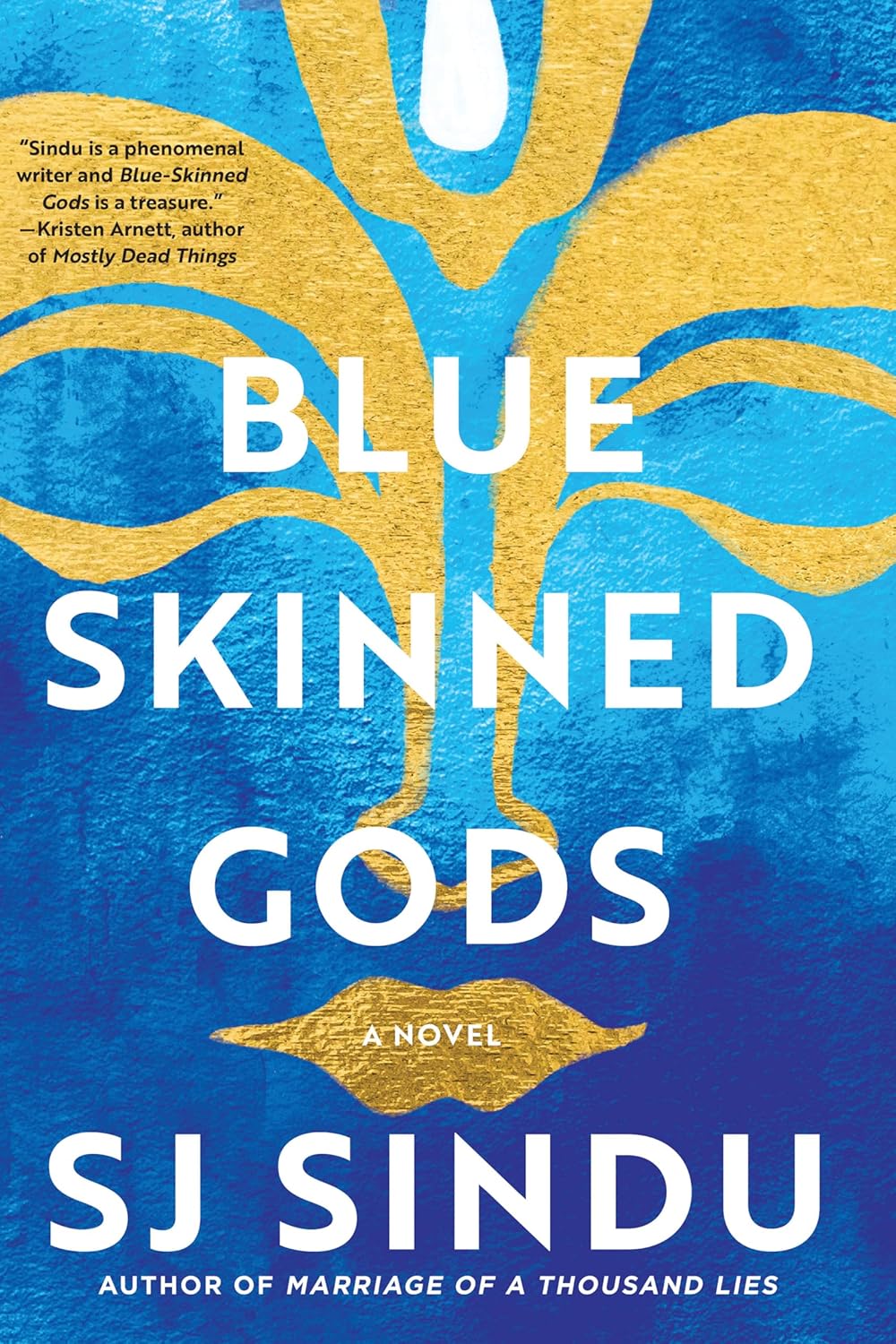
Blue Skinned Gods

My interest in reading about cults formed around religions is probably not in the same league as true crime fans, but when I find a gem like Blue-Skinned Gods by SJ Sindu, I drop everything else to read it. (Further proof that this was the right decision came in the form of a blurb on the cover from Roxane Gay who has a nearly flawless track record of recommending books that I thoroughly enjoy.)
Blue-Skinned Gods is the story of Kalki, narrated to the readers by the former child god himself. Purported to be the tenth incarnation of the Hindu god, Vishnu, people come from all over India and abroad to seek Kalki’s blessings and be healed by his touch. But there is no pretence that perhaps he is divine, no suspenseful unraveling of the truth. We know fairly quickly that this is all a show and that Kalki’s father is at the center as puppeteer and ring master. Formerly a practicing physician in the United States, he returned to India with his wife and the infant Kalki to set up their ashram. His own upbringing as well as being a doctor in the west prove instructional when it comes to tapping into and exploiting a particular spiritual and religious hunger within people. There is comfort in being so close to divinity and the belief that a god on earth can solve problems of any size.
It begins with discovering the truth of his blue skin. Treated bathwater and not, as Kalki and his followers had been taught, from absorbing the poison of a cobra bite. The idea of a god speaking through a child is utterly fascinating to me, far more than adults who purport themselves to be divine. If the skeptic believes children are more malleable does a believer see a child as a vessel, less corrupted by the world? Stories from the Hindu pantheon that Kalki knows by heart (his father doesn’t allow him any other forms of literature) are full of the gods and goddesses being flawed in both their true forms and as humans. Yet, Kalki is permanently under the weight of his father’s demands which are often enforced with violence and Kalki’s desire to unlock the full potential of his god powers is woven into wanting desperately to please his father.
It’s both heartbreaking and morbidly fascinating, the sheer amount of clarity in those who are closest to Kalki. That every day they help to further the lie of his godly identity, yet, in pivotal moments they expect him to slip out from under his father’s thumb as if it were the easiest thing in the world for someone who knows no other way of life. I found myself wishing that the author could have made him divine. His genuine desire to be the healer that people need, is exploited again and again and even after the first threads of his blue skin and the little white pills begin to unravel the carefully spun narrative of his life, he blames his failures on his inability to attain his full godly powers. Because the frightening truth is that if he accepts that his life has been a lie, he will be left with no idea of who he is.
The book is split between Kalki’s two lives. The one in the ashram and the one in New York as he tries to shed his god identity and become something else. Understandably, the start is chaotic, sexually charged, and at times dangerous as he is immediately dragged back into familiar patterns of life. But it is also beautiful as Kalki finally explores the desires of a body which has previously been nothing but a tool to be exploited and costumed in fake divinity. Something I also very much appreciated was Sindu’s approach to queer themes. There is nothing in Hinduism which condemns queerness and there is never a moment when Kalki feels guilt or questions his exploration of his sexuality.
There’s no lack of twists to Blue-Skinned Gods and as a generally anxious person I did have to resist the urge to thumb ahead in the book just to make sure that the characters Sindu had so beautifully developed and whom I had gotten attached to, were alright. By the end, there was still so much I wanted to know about Kalki’s life after New York. Maybe for the comfort of knowing after everything he’d been through, that he learned to be ok, like a follower of Kalki looking for a comforting conclusion. Even though the myth of the blue-skinned god is just that, a well told story, I was glad to spend the 370 pages with Kalki while he told his.
*Trigger warning, there is child abuse and some descriptions of sexual abuse