
A Seam of Gold

Pardon me if I’ve turned into one of those people who says “I was doing ‘x,y,z’ before it was cool.” But, I was into “get ready with me” before it became a social media trend. Although, much like today, I had to psych myself up for big events, what helped to mask my nerves was the process of the family getting ready.
Getting ready for an event that requires Indian clothes is a process. If you grew up in the diaspora and your family wasn’t taking regular trips to their respective motherland where you could stock up on all the latest styles, then you had to rely on local businesses. While the stores where I grew up are essential to the community, their stock all comes from India and is sold at insane markups which means you are naturally going to spend that money on formalwear. The last time I had to buy clothes at one of the shops it made me nostalgic for a time without smart technology. Not only has the volume of people bargaining at each other doubled in decibel, but now the shop assistants have forgone their calculators with enormous buttons the size of unshelled walnuts onto which they clacked fake calculations and are now doing the same on tablets, dramatically thudding and swiping flourishes across the screen like they’re playing piano with Little Richard.
Once you have your clothes and it’s time to get ready for a wedding (or wedding related ceremony), puja, or “wildcard” event, the first thing is to lay out your clothes at least four or five hours before actually getting ready. This is because there’s no way of storing them that won’t require ironing before every use. In my mom’s case, the more ornate saris were stored in an old suitcase from the eighties in mustard yellow hard plastic. The suitcase would be hauled onto the bed and opened out while I curled on the bed beside it, lifting up each neatly folded sari to examine the patterns and rub the material between my fingers for the umpteenth time.
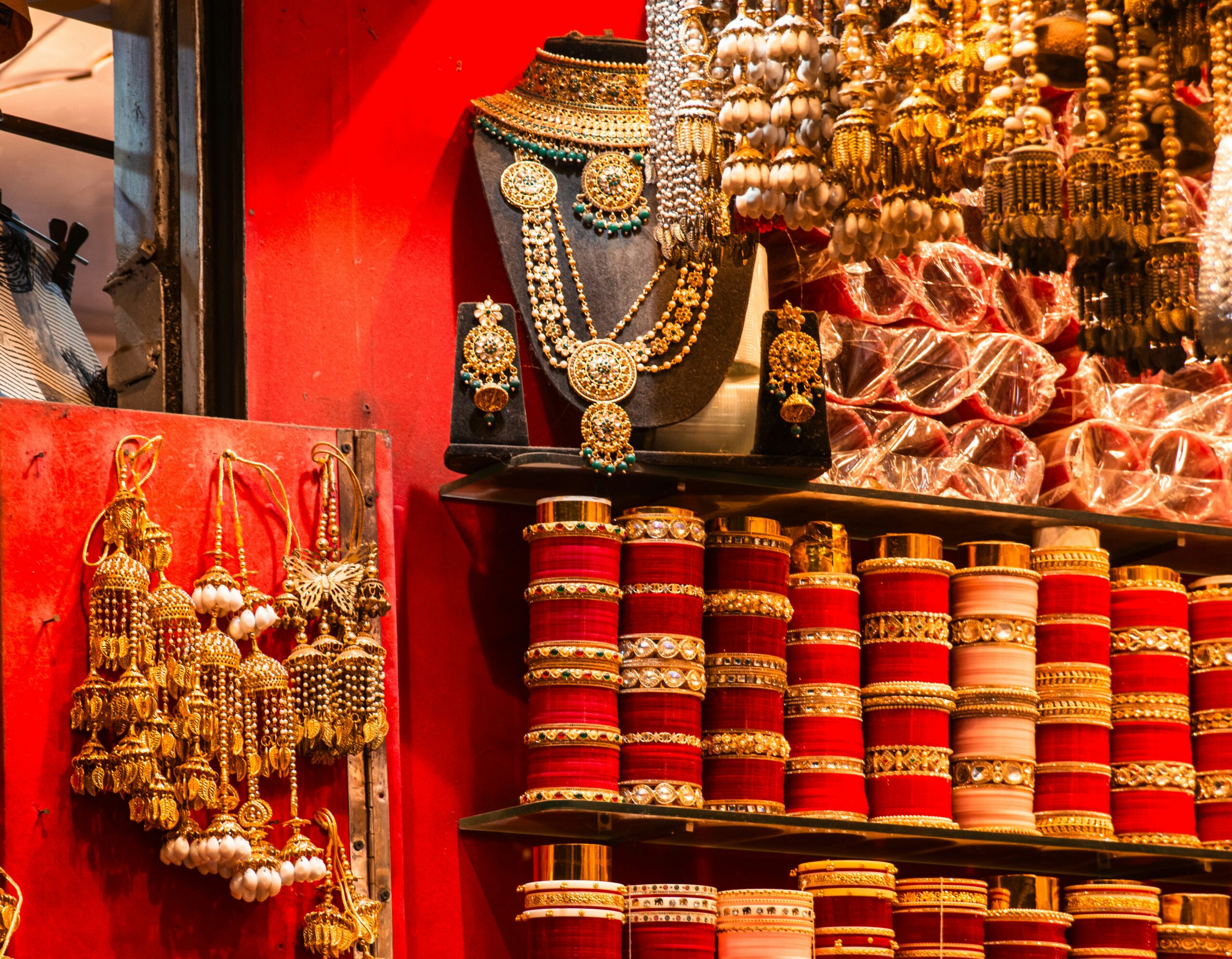
After the right clothing has been selected, the next step is to find the right jewelry combinations of earring, necklaces, bangles, and a tikka. The most common jewelry worn, especially when you’re younger, is just costume jewelry and it can be fun to mix and match different colors and styles with. But when it’s a more auspicious event like a wedding or puja, that’s when you bust out the gold. I never got tired of my mom lifting the lid on a jewelry case where she kept the “capsule” jewelry – pieces that could be worn with pretty much anything. They were unique and timeless.
The case smelled like the little vial of sandalwood oil she kept inside. I’m not sure how much help I was, since I was just taking things out to feel their warmth in my palms, and to squint at the patterns and lines that shaped them. My mom wasn’t one to keep her annoyance hidden when I asked the same question again and again, but it never seemed to bother her when I asked yet again about where things came from or if I could unwrap something to look at it. These pieces were representative of the new life she had embarked on when she married my dad.
My first pair of gold earrings were a gift from my grandparents when I was seven or eight. Tiny gold hoops, open at the back and shaped in a twisting pattern. They sparkled against my skin and made me feel special and beautiful. Receiving gold as a girl is a kind of rite of passage. It marks the beginning of your own treasury which will hopefully be gifted someday to your future children or grandchildren. But they were only for specific occasions. Gold with western clothing was considered tacky and an invitation to have them snatched. So after dutifully thanking both grandparents, the earrings were put back into their violently pink box where they rested on a fluffy little mound of cotton, and packed away for safekeeping.
Gold jewelry is always the last thing to go on before you get ready to leave the house. The final step in our house was that my dad fastened my mom’s necklace. The moment was special enough that it prompted a rare silence. Watching him fasten on her gold chain was symbolic of the life and family they had built up to that point, some of the weight of which was carried in the gold jewelry. Maybe it sounds corny, but even if I didn’t have the words to articulate it as a kid, I could still see the beauty in that moment.
Gold is a precious material in Indian culture. It represents prosperity, fertility, good fortune – basically, all the things you want to have when starting a new life and establishing a family. For Hindus, gold is also connected to the goddess Laxshmi. As well as its spiritual richness, it has also represented a quiet power in the hands of women for centuries when practices like dowry and bride price were common. Gold provided them added security in their marriages. Although the exact origins of dowry are unclear, there are records of it having existed all the way back to ancient Babylon. Its purpose was not only for the bride’s wellbeing, but perhaps to give her family some economic stability should they ever fall on hard times. Certainly in pre-Colonial India, women were in full control of their dowries. But when the British colonized India, they banned women from owning property which meant that whatever a married woman had was then ceded to her husband and in-laws. Naturally this was a vulnerability that a patriarchal society was frothing at the mouth to exploit. Even though dowry practices were officially banned in India in 1961, it continues to thrive, particularly in rural areas and dowry related murders are still very much a current topic.
Since India gained its independence, women’s property rights have been restored, but the significance of gold for women remains. Granted, there is still some fallibility in the power of gold ownership when you consider the danger that male partners, their families, even adult children’s greed can be obstacles. The memories are not lost on me, aunts and grandmothers with secret stashes of gold bangles, earrings, and simple chains. Don’t bother checking under the mattress. Older Indian women have a reputation for doing their banking in their bras, but that’s child’s play compared to their super squirrel skills when it comes to storing gold for life’s “just in case” moments. A feminine force disguised as ornamental beauty. In my family, going back the last few generations at least – unless someone from my family reading this decides to drop some shocking news – dowry was not given. Gifts are exchanged, for example, the bride’s family gives the groom’s family new clothes that they can wear at the wedding or the reception. (Keep in mind that migration can mean anything from complete and total rigidity to playing fast and loose with traditions, so this might be different in other communities.)
Even so, gold remains of unquestionable importance in the uniting of families, with pieces being gifted to the bride by her family, and sometimes her in-laws. It’s an act not only meant to bestow good fortune, it symbolically creates the links in an ever-expanding, hopefully ever-strengthening family. Undoubtedly there is a sentimentality attached to gold pieces because of where they came from or the occasion they represent. I loved going through my mother’s jewelry and it is important to me as an adult because they are a connection to her memory. But for married women whose only permitted possession is gold, this goes beyond symbolism. It can translate to real-world treasure like the power to escape an abusive relationship or the start-up capital for a business. Taking such practical uses into consideration, there was always the inherent understanding that a woman wasn’t so much the possessor as the guardian of the gold.
None of this is to say that gold hasn’t been a resource that leads to resource extraction and all of the blood and profits that follow. With that has come a very palpable shift in the way this precious material is treated on the microlevel, within family networks. The way we treat gold seems to have regressed to being more a status symbol than anything else. A sign of a successful family when they can own gold for pleasure rather than security. Part of me wants to believe that when this happens, it is because there are other forms of empowerment to pursue which would lessen the importance of gold as added insurance.
Education perhaps being the most critical. In my life there were certainly references to a future that would include a husband and children (usually it consisted of my mother telling me that even when I was 35 – not sure why she always picked that age specifically – and married with kids, I still wasn’t too old to be disciplined). But I was incredibly fortunate to grow up in a family where we understood from an early age that education is a gift not everyone is given and that the expectation we do something with that gift was not so that we would uplift a future partner.
But education and money are so tightly knotted, it doesn’t seem like you can really put their importance in two separate camps and greed seems inevitable either way. The idea that there will be a peaceful transfer of the family gold has, to my eyes, never been that straightforward. There are arguments over who should get what, who deserves what and how much, which one is cheating the others from their fair share. Sometimes the opinions or wants of the person passing down the gold changes. This yellow, precious metal which is too soft to create weapons has the power to break families. Instead of something which connects families or teaches girls from an early age the importance of having financial independence, what are people really fighting for apart from the desire to have something in their possession?
Not that I’m immune to greed or wants. I’m probably not built for motherhood, to be honest. The number of places that I leave old batteries laying around before I collect them all to be properly recycled is staggering. But maybe having a daughter would make me feel and act differently. Especially knowing that it would give her more financial security. There are moments that vault me into a realm purely fantastical where someone whose features are sprinklings of the people in my family I love the most is helping fold my faded collection of band t-shirts and choosing between the squirrel earrings or the cake slices which will be part of their inheritance.
But for now, I am focused on a different sort of empowerment. The most precious seam of gold that I possess is the thing that supports my child-free by choice lifestyle. Another quiet sort of power. That I can say all of these things about the value of independence and empowerment doesn’t dispel the fact that a few choice words can seemingly strip you of what makes you feel confident in yourself, or at least whenever you think you’re doing all of the right things. When that happens, I still don’t know the best way to respond that isn’t just, “letting it go,” ignoring it and making yourself deliberately smaller.
I think about these moments from time to time and my last visit to the gynecologist’s office to discuss the aforementioned gold seamed device has reactivated these thoughts. While my regular doctor is lovely, she also needs holidays, so on this day I was in the hands of her colleague. Having dealt with him before, my heart sank when the door swept open with unnecessary drama and I saw him standing there. I’m not against having a male gynecologist. If anything, maybe we need to get more open-minded men in this field if for no other reason than to teach men that women cannot in fact, hold in their periods like pee… My problem with this doctor – not uncommon I suspect – is his ability to condescend in both directions. If you have thoughts, they’re meaningless since you didn’t go to medical school. When you ask questions, you’re talked down to for not knowing what should be obvious.
In contrast to the sensible conversation I’d had with my usual doctor, I sat in the examination room while he did most of the talking and ploughed over the few sentences I tried to squeeze in. It was more like listening to a bizarre sales pitch than having a medical consultation. The basic gist was that if you have an IUD for seven years, you will need to get a new one because they are far less effective. It used to be five years for non-hormonal IUDs, but then it was changed to seven. The good doctor however, informed me with a jolly wave of all ten fingers that this was just marketing nonsense and that actually they were good for ten years.
This may indeed be the case and a quick internet search will confirm that some brands of IUD can last that long. But, this was something I had already discussed with my actual doctor, which he knew. So it wasn’t for him to try and steamroller that plan. Maybe he really was, in his own obnoxious way, just trying to save me pain (because it’s a fucking – only appropriate adjective in this case – painful process) and time and money, who knows. At the end of the day his delivery made it hard for me to care about his motivations. He seemed to think the reason I wasn’t speaking had nothing to do with his yapping, so he took it upon himself to clear up what he thought was my confusion.
This was more or less his explanation: If you get this (IUD) in Germany, everyone will tell you it’s good for seven years. The company, the pharmacy, the doctors. It’s all marketing *insert conspiratorial eye roll*. If you go to India and ask for the exact same device from the pharmacy, they will tell you ten years. And it’s not because they are trying to trick you into having more children.
Ok, clearly there’s a few things to unpack here. I’d like to start by addressing this whole, changing five years to seven as a marketing strategy. Because that sounds like a terrible one to me. It’s like saying, “back in my day we had to buy more things because the quality was shit and they didn’t last long! Now we just own the same clothes, furniture, and electronics for years! Young people have no idea how exciting life was back then!” On Las Vegas Boulevard in the US is the Graceland Chapel where you can have your marriage officiated by an Elvis impersonator. Depending on which wedding package you choose he will sing up to three songs. That means you can have ‘Hawaiian Wedding Song,’ ‘Love Me Tender,’ and ‘Can’t Help Falling in Love.’ I’m not an Elvis fan, but that seems like a better example of effective marketing. Bumping up the efficacy of a contraceptive device from five years to seven, but for some reason, refusing to market it at ten years doesn’t seem like quite the money-making scheme to me. Again, maybe I know nothing.
Oh, right, then there was that last part; the snide reference to India’s birthrate. At that moment I defaulted to my new response which is just a frosty silence and a direct, dead-eyed stare that doesn’t just betray zero emotions, it looks like your eyes are going to become all pupil and consume their soul. Unfortunately it doesn’t work if the person isn’t paying attention, but imagining harvesting their soul at least keeps me from getting angry or trying to educate them. Maybe it’s not helpful, but at this point I feel like it’s no longer my responsibility to turn every ignorant remark into a teaching moment – one which will likely be ignored or forgotten. I’ve had enough of giving grace to people whose main driver of ignorance is “this is how we’ve always talked and suddenly people are getting offended by every little thing.” While I’m not going to start cutting off anyone who makes jokes or remarks that are not ok – because sometimes the latter really can come from not knowing – it does mean I’m going to work towards no longer going to be minimising the sting with an uncomfortable laugh that trails off into silence and therefore equates to permission. It’s the kind of reaction that makes you feel like a “pick-me” because your willingness to tolerate thinly veiled insults makes you more palatable and the ugly truth is that that’s often necessary.
So any fury I feel in these moments just steeps inside me while my insecurities flare at the same time. Did I misunderstand it? Am I just blowing things way out of proportion? When someone makes racist or sexist remarks towards me, it takes a lot of energy to try and engage meaningfully or argue back and most of the time that’s spent on being ignored. I’ve been cut off, talked over, and (the classic route) convinced that it’s my fault for misunderstanding and yet my first instinct is still to question my own reaction first. My guess is that it comes from years of the stupid advice that is to not let it bother you, just ignore it. That’s not a long-term solution. As if being two children no older than ten calling me the N-Word and pretending to throw stones while a tram full of adults looks on in bored silence is supposed to have zero emotional effect on me. Ignoring things that make a person feel powerless doesn’t magically restore it.
There are many times when I’ve let comments pass because of the power dynamic. While on the phone to a person who would potentially be giving me some teaching work, he decided it was also the right time to tell his favorite joke. (Pro Tip: anytime someone asks you about your ethnic background and follows it up with “humour” it’s probably a bad sign).
Without the opportunity to frost him with my glacial stare, I tried to infuse as much scorn as possible into the sound I made in response. Whether or not he was a nice enough person to deal with in other ways, how are you supposed to have any understanding when something is so deliberately aimed at you by someone who could easily pass the paid work on to another person? It’s the same anger I felt having to sit quietly in the gynecologist’s office. There’s not much more that can make you feel vulnerable than getting an offensive remark followed by the words I have come to dread as a woman “bitte machen Sie sich untenrum frei.”
For what it’s worth and yes, I’m aware of the sublevel location of the bar being set, I’ve been fortunate when it comes to encountering racism. The number of positive experiences with white Germans far outweighs the negative. Even so, I would still say that the worst of my experiences were when people in positions of authority were exercising their pocket-sized bit of power over me. Every little cutting comment, patronising exchange, supposed humour, or someone just yelling at you for no apparent reason, stays with you. It builds up, until one comparatively small remark threatens an implosion like at the doctor’s office. (Implosion as opposed to explosion because the latter is a luxury. Lest you be classed as a typically angry and ignorant minority.)
Later that night, unable to fall asleep, I mentally rifled through past experiences, yet again wondering if I even had the right to be bothered while still feeling upset all the same. I’ve done the things that you supposedly have to do to be accepted: learning German, having a job and earning money, paying my bills, trying to integrate into the culture and finding community. Except that a foreign face and a foreign name means first, that there is some unspoken “right” to use words to dismiss and belittle all of those things.
Not that this is a new discovery of course. Yes, the comment itself was comparatively mild (albeit rude as hell) but it came at a time where I was irked enough to feel compelled to write about it – and to yet again take you, dear faithful reader, on a romp through my childhood. It’s probably also upsetting because times are changing fast. More and more it feels as if the guardrails have fallen off for ordinary people so that they can say insulting or racist remarks as though they are facts and not even bother with the courtesy of excusing themselves with “I’m not racist but…” before delivering a barb. Maybe the reason I thought about an ancient system of empowerment is because it offered one of the few tangible ways I can express just how scary everything feels right now. I don’t know. I just hope my doctor is back from vacation.